
Wondering what the difference is between pneumatic and hydraulic chucks? This article will answer your questions. We analyze and compare pneumatic and hydraulic chucks from multiple perspectives, including their advantages and disadvantages, applications, market share, service life, and maintenance guidelines. Find out more here!
What is a pneumatic chuck?
A pneumatic chuck is a clamping device that uses compressed air to clamp and release workpieces. Its operating principle is that a cylinder pushes a piston, converting compressed air pressure into a mechanical clamping force, thereby securely holding the workpiece. Because the air source can be adjusted at any time, pneumatic chucks are flexible and responsive, making them particularly suitable for machining environments requiring high-frequency clamping and rapid part changes.
In modern machining, pneumatic chucks are commonly used on CNC lathes, drilling machines, milling machines, and automated production lines. Their advantages lie in their relatively simple structure, low energy consumption, and fast response time. For machining conditions requiring high precision but relatively moderate clamping force, pneumatic chucks offer an excellent balance between efficiency and cost, making them a common clamping tool used in small and medium-sized factories and for mass production of parts.
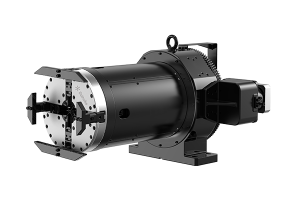
What is a hydraulic chuck?
A hydraulic chuck is a device that uses a hydraulic system to securely clamp a workpiece. A hydraulic cylinder within a hydraulic chuck utilizes liquid pressure to generate a stable and powerful clamping force, keeping the workpiece stationary during machining. Compared to pneumatic chucks, hydraulic chucks offer stronger clamping force and are suitable for heavy-duty machining, large parts, and high-intensity cutting tasks.
Hydraulic chucks are widely used in high-precision CNC lathes, grinders, heavy-duty turning centers, and aerospace parts processing. Because they maintain stable clamping force over time and can withstand the shock and vibration of high-power cutting, hydraulic chucks are often considered core clamping equipment in high-end manufacturing.
What is the difference between pneumatic and hydraulic chucks?
While both are common clamping devices, they differ significantly in their principles, performance, and applications:
- Drive Method
Pneumatic chucks: Driven by compressed air, suitable for light and medium-intensity machining.
Hydraulic chucks: Driven by liquid pressure, suitable for heavy-duty cutting and high-intensity clamping.
- Clamping Force
Pneumatic chucks: Clamping force is relatively low, but sufficient for small and medium-sized workpieces.
Hydraulic chucks: Clamping force is strong and stable, ensuring long-term stability.
- Response Speed
Pneumatic chucks: Response speed is fast, suitable for production lines with rapid part changeovers. Hydraulic chucks: Stable operation, but slightly slower response speed than pneumatic systems.
- System Complexity
Pneumatic chucks: Simple structure and easy maintenance.
Hydraulic chucks: Complex system, requiring a hydraulic pump station and piping, and requiring high maintenance.
- Cost Investment
Pneumatic chucks: Low initial investment and relatively economical operating costs.
Hydraulic chucks: High equipment costs, but suitable for long-term, high-volume, high-intensity production.
Market Share Analysis of Pneumatic and Hydraulic Chucks
In recent years, with the development of CNC machine tools and intelligent manufacturing, the chuck market has shown a clear trend of differentiation:
Pneumatic chucks: Hold a large share in small and medium-sized factories and light industrial processing. According to industry statistics, their market share remains approximately 40%-45%, primarily concentrated in applications with rapid part changes such as electronic components, automotive parts, and precision machinery.
Hydraulic chucks: Due to increasing demand from high-end manufacturing and heavy industry, they hold a market share of approximately 55%-60%, particularly dominant in the aerospace, military, and large-scale equipment manufacturing industries. It is expected that in the future, as the trend of environmental protection and energy conservation strengthens, pneumatic chucks are expected to gain more market share in lightweight processing, while hydraulic chucks will continue to dominate the high-end manufacturing field.
Advantages and Disadvantages of Pneumatic and Hydraulic Chucks
- Advantages and Disadvantages of Pneumatic Chucks
Advantages:
Fast response speed, suitable for rapid workpiece loading and unloading.
Simple structure, easy installation and maintenance.
Low cost, suitable for small and medium-sized enterprises.
Can achieve a certain degree of energy conservation and environmental protection.
Disadvantages:
Limited clamping force, unable to meet heavy-duty machining needs.
Low stability during long-term clamping compared to hydraulic systems.
Significantly affected by air source pressure fluctuations.
- Advantages and Disadvantages of Hydraulic Chucks
Advantages:
Strong and stable clamping force, suitable for high-intensity cutting.
Maintains stable clamping force for a long time and is not prone to loosening.
Suitable for large parts and high-precision machining.
Disadvantages:
Complex system, requires hydraulic pump and piping.
High maintenance cost, possible fluid leakage.
Large initial investment, relatively high energy consumption.
How do pneumatic and hydraulic chucks perform?
In terms of performance, pneumatic chucks excel in flexibility and speed, while hydraulic chucks excel in stability and clamping force.
Pneumatic chucks significantly improve efficiency in high-frequency machining and are suitable for tight-cycle assembly line operations.
Hydraulic chucks perform better in high-pressure cutting and long machining times, ensuring that the workpiece does not shift, making them suitable for manufacturing tasks requiring high precision.
Applications Suitable for Pneumatic and Hydraulic Chucks
Pneumatic Chuck Applications:
Small and medium-sized CNC lathes and drilling machines.
Lightweight machining of automotive parts.
Electronic component and precision device production.
Automated assembly lines requiring fast loading and unloading.
Hydraulic Chuck Applications:
Heavy-duty CNC lathes and large machining centers.
Aerospace parts manufacturing.
Machining of military equipment and large machinery parts.
Industries requiring strong clamping force and long-term stability.
What is the service life of pneumatic and hydraulic chucks?
The lifespan of a chuck is closely related to the quality of the equipment, frequency of use, and maintenance:
Pneumatic chucks: The average lifespan is approximately 3-5 years, which can be extended to 7 years with proper maintenance. Its lifespan is primarily affected by the quality of the air supply and seal wear.
Hydraulic chucks: Due to their sturdier construction, their average lifespan is 5-8 years, with some high-end products exceeding 10 years. However, regular replacement of the hydraulic oil and seals is required.
Pneumatic and Hydraulic Chuck Maintenance Guide
Pneumatic Chuck Maintenance
Regularly check the air supply pressure to maintain stability.
Inspect the seals to prevent leaks.
Clean out internal impurities to prevent air line blockages.
Regularly lubricate to extend service life.
Hydraulic Chuck Maintenance
Regularly check the hydraulic oil quality and quantity to keep it clean.
Replace worn seals to prevent fluid leaks.
Inspect the piping for leaks or blockages.
Monitor the operating status of the hydraulic pump to prevent overloads.
Conclusion
Pneumatic and hydraulic chucks, as the most important clamping devices in machining, each have their own unique advantages and limitations. Pneumatic chucks are characterized by flexibility, speed, and low cost, making them suitable for small and medium-sized workpieces and high-frequency production. Hydraulic chucks, on the other hand, are known for their strong clamping force and stability, making them suitable for heavy-duty cutting and high-precision machining.
For companies, the choice of chuck depends on a comprehensive consideration of workpiece size, machining intensity, production capacity requirements, and investment budget. In the future, with the advancement of automation and intelligent manufacturing, both types of chucks are expected to play a greater role in different market segments.